- Telephone
- Email
Cobbold Gorge Nature Reserve continues to reveal more treasures, with a striking new species of rock-dwelling monitor lizard, the Orange-headed Rock Monitor (Varanus umbra), formally described recently.
The Orange-headed Rock Monitor has been seen and photographed by Cobbold Gorge’s Savannah Guides over the past few years. Initially it was thought to be a Freckled Tree Monitor (Varanus tristis orientalis), but further research has revealed it’s an entirely new species.
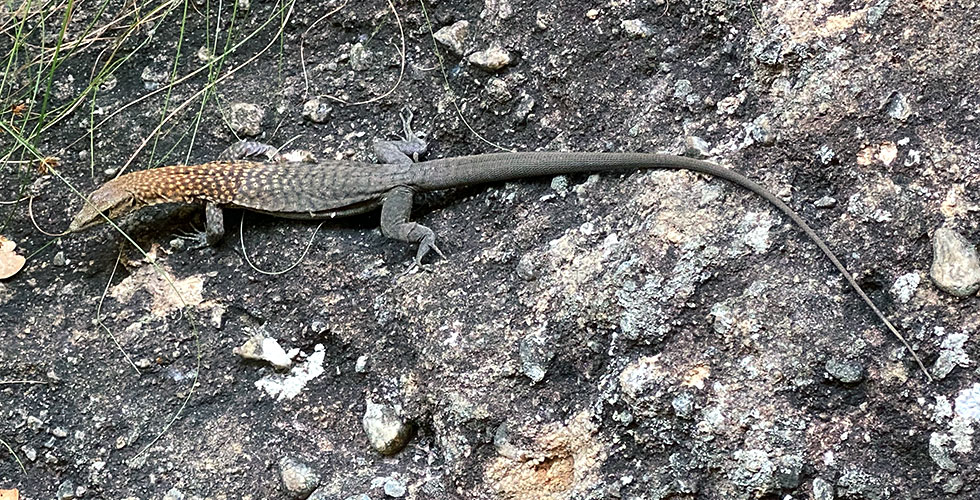
New Rock Monitor Lizard species discovered at Cobbold Gorge Nature Refuge
The Orange-headed Rock Monitor is noticeably different from other rock monitor species found across Australia’s savannah regions. As its name suggests, it has a distinctive orange to yellow-brown head and neck, rather than the darker spotted colouring seen in related species. It is also slightly smaller, with a more flattened body suited to living among sandstone rock formations, and its pattern of spots fades toward the tail rather than continuing along the entire body.
Dr Stephen Zozaya from the Australian National University (ANU) was shocked when his colleague Wes Read spotted the Orange-headed Rock Monitor for the first time.
“I was like, ‘What is that?'” Dr Zozaya said. “I had no idea these things existed, and it turns out a few photos had showed up online.”
At this stage it is believed the Orange-headed Rock Monitor is only found in and around Cobbold Gorge sandstone and towards Rungulla National Park. This is one of three rock monitors, formally recorded from the eastern Australian savannahs.
“Australia has a few rock monitors, but they’re all known from much further west,” Dr Zozaya said. “We were blown away when the first genetic results came back. These three species are more distinct from one another than many monitor species that have been recognised for decades,” Dr Zozaya said.
The Cobbold Gorge Nature Refuge covers 4,720ha of sandstone escarpment and dry savannah and was established in 2009 in partnership with the Queensland Government, to protect several vulnerable and rare plant species, and it also forms important wildlife corridors and catchment linkages in the area – a special place. We look forward to more exciting discoveries of the unique flora and fauna of our area, in years to come.
For more information, see:










© Cobbold Gorge 2026